We talk a lot about strength. We talk about cardio. But mobility, arguably the foundation of everything our bodies do, rarely gets the attention it deserves. Whether you’re chasing a toddler, sitting at a desk for eight hours, or simply trying to stay active and independent as you get older, your mobility is quietly determining the quality of every movement you make.
Here’s what physiotherapy science actually tells us about it.
What Is Mobility?
Mobility is not the same as flexibility. Flexibility refers to the passive length of a muscle -how far it can be stretched. Mobility is a more complex, active quality: it is your ability to move a joint through its full range of motion under muscular control. True mobility requires adequate flexibility, yes, but also neuromuscular coordination, joint stability, and tissue health.
From a physiotherapy perspective, this distinction matters enormously. A muscle that is passively long but poorly controlled offers little functional benefit, it can even increase injury risk. (Those of you who are hypermobile will know this already!) What we are aiming for is controlled range of motion: the ability to move freely, load tissues appropriately, and stabilise effectively at end range
What Ageing Does to Your Joints
From our mid-thirties onwards, joint range of motion begins a measurable, progressive decline (Stathokostas et al., 2012).
- Collagen fibres stiffen,
- Joint fluid production diminishes,
- Neuromuscular control becomes less sensitive
Sarcopenia (age-related muscle loss) affects both strength and active support structures around joints, which can restrict functional range
Reduced mobility is one of the strongest predictors of falls and loss of independence in older adults (WHO, 2020), but read on, there is lots we can do about it.
The Problem with Sedentary Life
Prolonged sitting, whether at a desk, in a car or on the sofa has well-documented effects on musculoskeletal health (Booth et al., 2012). The WHO estimates that physical inactivity is now the fourth leading risk factor for global mortality, and its effects on mobility are felt long before any formal diagnosis is made. Prolonged sitting is associated with adaptive shortening of the hip flexors, lower back stiffness and pain, increased thoracic flexion, restricted neck and shoulder range of movement.
How Injury Compounds the Problem
Injury triggers protective muscle guarding that, without proper rehabilitation, becomes chronic — restricting joints long after tissue healing is complete. As little as one to two weeks of immobilisation causes measurable connective tissue shortening that can take months to reverse. Persistent pain also alters muscle recruitment, creating compensatory patterns that load adjacent joints and quietly erode range of motion over time. This is why an old ankle sprain can eventually contribute to knee or hip pain — the mobility deficit was never addressed.
Why Targeted Mobility Matters
Understanding the distinct mechanisms behind reduced mobility is helpful. When we understand why we might be less mobile that we would like and how and where this affects us, we can be much more effective with treating it.
While generally all movement is good, the same mobility programme does not serve everyone equally well. Older adults need progressive loading and balance training, not aggressive stretching. Sedentary individuals need directional motor re-education, not just more movement. People recovering from injury need graded re-exposure and neuromuscular retraining, not just passive flexibility work. Generic mobility routines cannot account these but a physiotherapist can.
The Evidence for Pilates
Pilates is one of the most well-evidenced approaches to therapeutic mobility work. Research demonstrates significant improvements in flexibility, balance, posture, and lumbo-pelvic motor control (Kloubec, 2010; Rydeard et al., 2006; Wells et al., 2012). Crucially, pilates trains mobility not just flexibility — the breathing, axial elongation, and controlled movement through range activate the deep stabilising musculature while challenging joint range simultaneously.
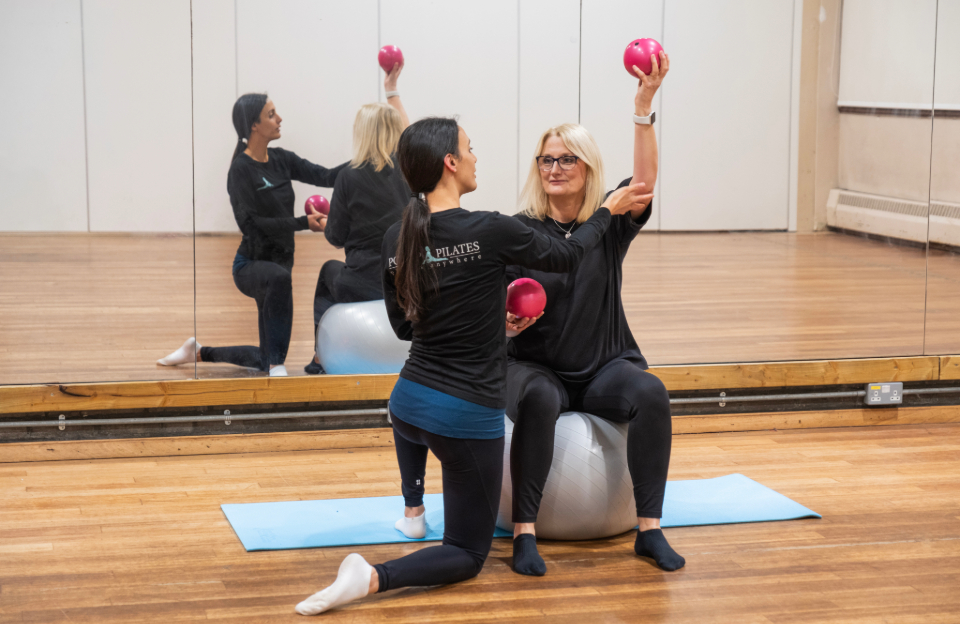
Mobility is not a luxury reserved for athletes. It is a clinical necessity for anyone who wants to move well, age well, and stay out of pain. If you’d like to experience what physio-led pilates can do for yours, we’d love to welcome you to one of our small group classes at Pop-Up Pilates.
8-Week Mobility Programme — What to Expect
This course takes you on a guided journey through the key areas of your body, building awareness and mobility week by week.
We start by laying the foundations — learning how to tune into your body and notice where you feel stiff or restricted. From there, each week focuses on a different region: your ribcage and mid-back, hips, neck, feet and ankles, lower back and pelvis, and shoulders. We finish by bringing it all together, applying everything you’ve learned into flowing, connected movement.
Throughout the course you’ll use equipment like foam rollers, resistance bands, balance pads, and Oov balls to help you explore your range of motion safely and with control. The focus is never just on stretching — it’s on building the strength and body awareness to move freely and confidently in everyday life.
By week 8, you should notice greater ease of movement, better posture, and a stronger sense of how your body works as a whole.